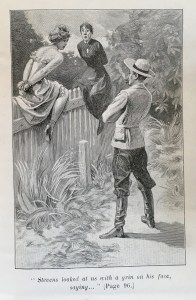
This one was an enormous challenge, and is listed here as a first draft, a clandestine reissue of a title published by Carrington in 1899, this edition profusely illustrated, the earlier edition as far as I can ascertain was not illustrated. I have attempted to make sense of the Mendes bibliographical,information only to find it confusing and uninformative, from reading his notes on this edition, it is obvious that he has not seen the 1899 edition. He states that Carrington “lost his nerve” and decided to go clandestine on the 1904 edition but does not speculate as to why? My theory is that the illustrations are the reason, if Mendes is correct, the in text illustrations in the 1904 edition are lifted from ” Le Beau Negre” (1902) (Carrington) , which I haven’t seen, but from modern day reportage, appears to have been a critique of the slave trade in the southern United States, which presumably gave Carrington a ready supply of flagellation material. The inclusion of these illustrations in the 1904 Dolly Morton along with the additional 10 engraved illustrations, in what is a pornographic novel is pushing the limits a bit., to say the least, especially when you look at Dola’s head and tail pieces to the rather sanctimonious introduction, which surely cannot have appeared in “Le Beau Negre”. I would like to know exactly which of the decorative illustrations (engraved plates aside), appear in both of the books in question.
Because of the fine paper, the binding and the scarcity and value of this book, I am only presenting “open book” scans, so no flattened images.
Updated with additional photographic images of full page illustrations 03/03/20
I await some further developments in consultation with a fellow bibliophile, and will update this post as and when i find anything new to share.
Updated following communication with Patrick Kearney Feb-March 2020.
My comments plain text Patrick’s in italic, the “Peter” referred to is Peter Mendes.
Steve, hi :
I just spoke to Peter about your edition of “Dolly Morton.” He has actually
seen the first edition, but didn’t describe it because it wasn’t clandestine.
Textually it is identical to the 1904 edition.
The reason Carrington published the second (1904) edition secretly was
because he was beginning to have problems with the law, and was on the
verge of doing a runner to Bruxelles. The illustrations were not a problem
however since, as you note, they had been used earlier for an openly
published edition of a different work on a related subject.
Carrington’s French translation of “Dolly Morton” was published openly
because he cut out the sex scenes. The flagellation scenes were retained
as they were less of a problem for the law, which in itself is a perversity
to my mind.
Best wishes
Pat
Thanks for that Pat, partially answers my question, but does not confirm
that the 1899 edition was unillustrated, which I believe to be the case.
And from a listing I found of Le Beau Negre there were no hors- texte,
which means the 10 hors- texte in 1904 Mémoires were commissioned for that edition.
Dear Steve :
I’m not sure that the original edition of Dolly Morton did have
illustrations. The Dawes copy in the Private Case has none,
and no others in captivity that I’ve been able to locate do either.
Library catalogues *usually* indicate the presence of plates or
illustrations, although rarely go to the trouble of counting them.
Incidentally, the only copy of the first edition in any major UK
research library is held by the BL.
I do agree, though, that if the illustrations to “Le Beau negre”
were all in-text, the 10 hors-texte in the 1904 Dolly Morton
were very likely done specially for that edition.
Best wishes
Pat
Many thanks Pat
That answers my questions, and I shall update the blog with yours
and Peter’s information.
I’m still curious about “Le Beau Negre“, I missed a copy just a
few weeks back, I cannot quite understand what the content would be,
as Carrington had already covered Dolly Morton in the desexed
version “En Virginie”. Yet if the story line was close enough for
the en texte illustrations to be transposable, was it just a rehash of Dolly Morton?
Dear Steve :
I rather doubt that the two books — “Beau negre” and “D. Morton” — are
related, except thematically. The former is by Hector France, the “Musk,
Hashish & Blood” man, while the latter of course is ascribed to Grassal.
Carrington seemed interested in flagellation works, but whether from his
own fancies or those of his customers I am unable to say. Perhaps a
combination of the two? Slavery and a Civil War fought to suppress it
seem ready-made subjects for novels about the domination of women
and so it’s not surprising that Carrington’s hacks used the topic. Hector
France is dismissed rather briskly by Wikipedia as an “auteur de
nombreux récits à caractère érotique” with no further biographical
information save for his dates (1837-1908) and a short-title list of his
works. His best known book, “Musk, Hashish and Blood” seems famous
mainly because of its title, which is certainly piquant. It appears to be a
translation of a work called “Sous le burnous” (1886).
Warmest regards
Patrick
My warmest thanks to Pat Kearney, for his advice and for his permission to post it.

Anon;(Georges Joseph Grassal ) The Memoirs of Dolly Morton. Philadelphia: Society of Private Bibliophiles (Charles Carrington) n.p. (Paris) 1904.
8vo. 303pp. Title page framed in red. 10 half-tone steel engravings and numerous text illustrations (mainly head and tail pieces). by George Dola. Printed on smooth wove paper. Issued for subscribers in an extremely small edition of 100 copies at a cost in 1904 of £3,3.0. (Three guineas).
The engravings are signed G.D. [i.e. G. Dola]. The text illustrations were first used in Carrington’s Le Beau Negre, published in 1902 [Mendes: 160-A]. The author has been falsely attributed to Hugues Rebell [Georges Grassal] and/or Jean de Villiot, which is actually a collective name/pseudonym. It has been suggested that the author is Hector France [Mendes: 160-A]. Carrington published the French translation clandestinely as En Virginie in 1901, which retains the flagellation scenes but expurgates all the sexual descriptions. This work was also published by Jean Fort under his imprint Collection des Orties Blanches in c.1917 as Dolly Morton with author as Donovan Kipps, illustrated with 7 plates Louis Malteste; and again as The Memoirs of Dolly Morton in c.1928, which is a reprint of Carrington’s En Virginie.


Preface




for detail about this title and author see:-
http://www.alexislykiard.com/translations/memoires_of_dolly_morton.htm
See also
Books for Trade: Jean de Villiot; Camille et Moi: La Flagellation à Travers le Monde, PARIS Charles Carrington; 1904
This Book is Not for Sale


